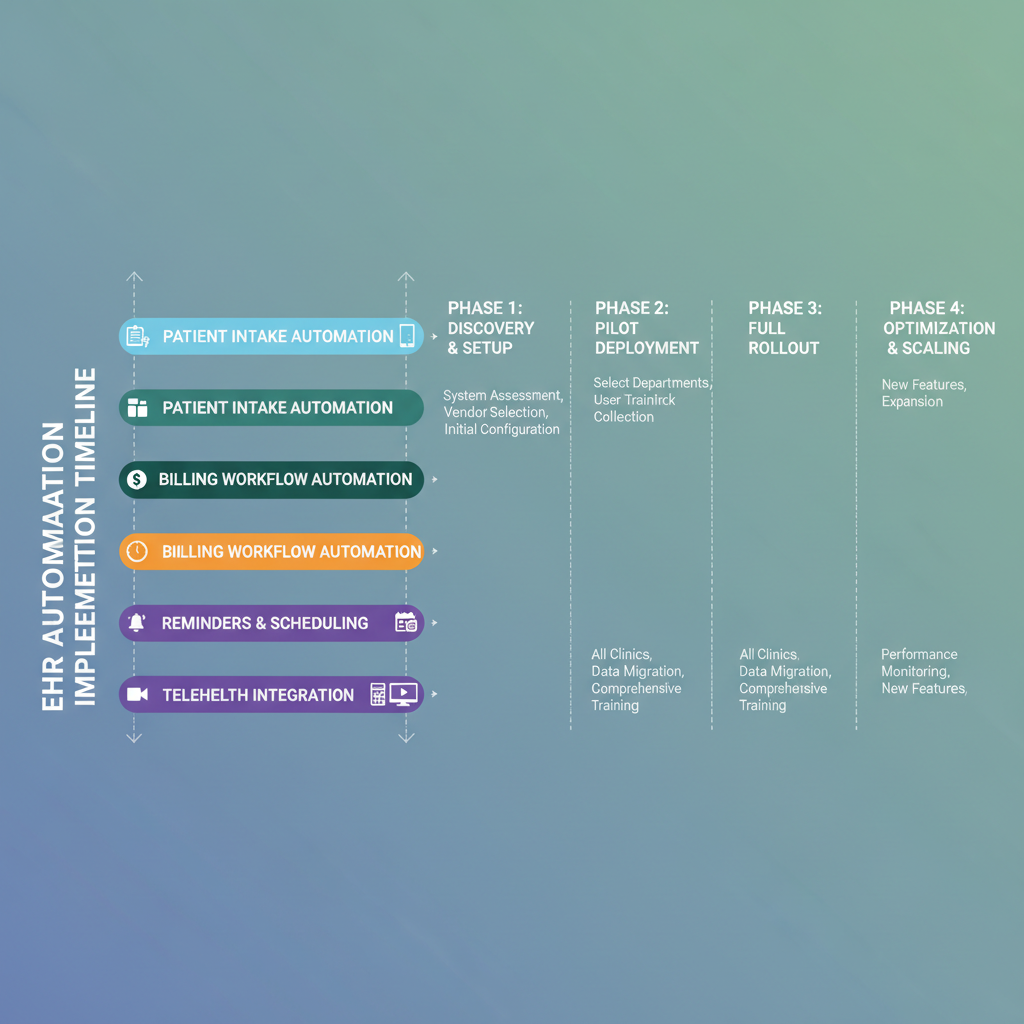
The biggest risk in EHR automation is not the technology — it's the implementation. Practices that try to automate everything at once, without a structured rollout plan, create disruption that undermines adoption and erodes the ROI they were trying to capture. A phased, workflow-by-workflow approach is the only reliable path to full automation without operational chaos.
Phase 1: The Workflow Audit (Weeks 1–2)
Before deploying any automation, NYC Healthcare Marketing conducts a comprehensive workflow audit — mapping every manual step in your current patient intake, insurance verification, billing, reminder, emergency coordination, and telehealth processes. This audit identifies the specific bottlenecks, error points, and time sinks that automation will address, and establishes the baseline metrics against which ROI will be measured.
- Map every manual step in all five core EHR workflows
- Identify bottlenecks, error rates, and time costs for each step
- Document current EHR platform configuration and integration capabilities
- Establish baseline metrics: denial rate, check-in time, no-show rate, staff hours per workflow
- Prioritize workflows by impact and implementation complexity
Phase 2: Integration Setup and Testing (Weeks 3–5)
Integration setup connects the automation layer to your existing EHR platform in a staging environment — not in production. Every integration is tested against real workflow scenarios before going live, with rollback protocols in place for every component. This phase also includes configuration of HIPAA-compliant data handling, role-based access controls, and audit logging.
Phase 3: Staff Training and Change Management (Weeks 4–6)
Automation only delivers ROI if staff use it correctly. NYC Healthcare Marketing provides role-specific training for every team member affected by the automation — front desk, billing, clinical staff, and administrators. Training is delivered in the staging environment so staff can practice with real workflows before go-live, reducing anxiety and accelerating adoption.
- Role-specific training modules for front desk, billing, clinical, and administrative staff
- Hands-on practice in staging environment before go-live
- Quick-reference guides for every automated workflow
- Designated super-users in each department for peer support
- Escalation protocols for edge cases that fall outside automated workflows
Phase 4: Go-Live and Monitoring (Weeks 6–10)
Go-live is phased — typically starting with patient intake and insurance verification in week 6, adding appointment reminders in week 7, billing automation in week 8, and emergency coordination and telehealth in weeks 9–10. Each workflow goes live with a 30-day monitoring period during which NYC Healthcare Marketing tracks performance metrics, identifies edge cases, and makes configuration adjustments.
Practices that follow a phased implementation framework achieve full EHR automation deployment in 6–10 weeks with near-zero rollback incidents — compared to 40% rollback rates for practices that attempt all-at-once deployment.
Ongoing Optimization After Go-Live
EHR automation is not a set-it-and-forget-it deployment. As your practice grows, adds providers, changes EHR platforms, or expands services, the automation layer must evolve with it. NYC Healthcare Marketing provides ongoing optimization as part of every engagement — monitoring performance metrics, updating integrations when payer requirements change, and adding new automation capabilities as they become available.
Frequently Asked Questions
Can we implement EHR automation while the practice is fully operational?
What happens if an automated workflow fails or produces an error?
How do we measure whether the automation is working after go-live?
Ready to Implement These Strategies?
Our healthcare marketing specialists handle everything — from technical SEO to content creation to review management. No long-term contracts.
Get a Free Consultation